

Aluminium in LV Fuse-Links: When Standards and Hard Data Say “Yes”
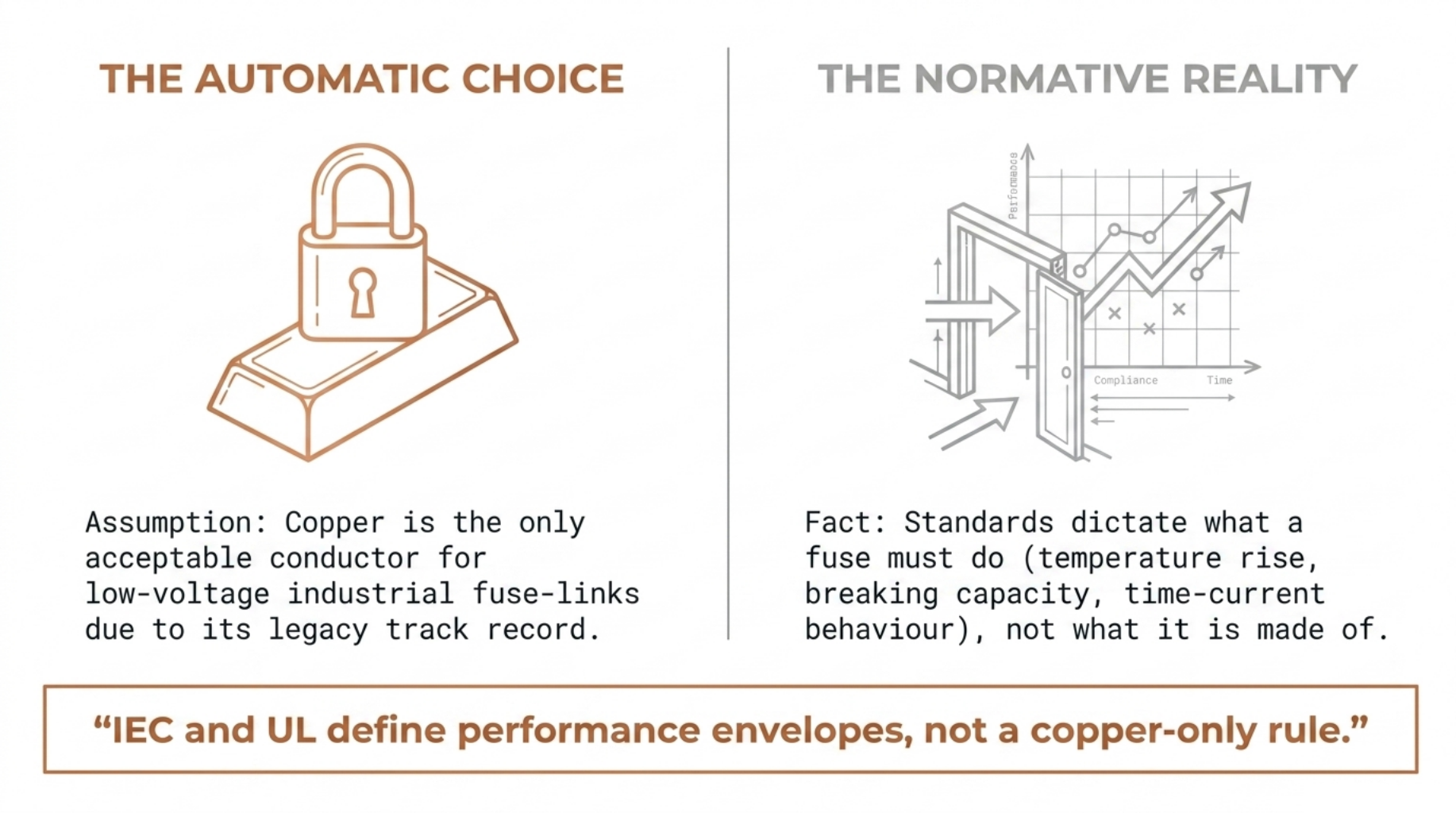
For decades, copper has been the automatic choice inside low-voltage industrial fuse-links. It is familiar, highly conductive and backed by a long field track record. Yet, when you open the standards that govern LV fuses, you do not find a copper mandate – you find performance requirements that a well-designed aluminium fuse-link can also meet.[2][3][4][1]
This final article in our series looks at aluminium not from the perspective of opinion, but from the perspective of IEC and UL standards, test regimes and measurable physical data. The conclusion is clear: for LV industrial fuse-links, aluminium is not a compromise material; it is a standards-compliant, future-ready alternative when engineered correctly.[3][4][5][1][2]
What IEC and UL Actually Specify (And What They Don’t)
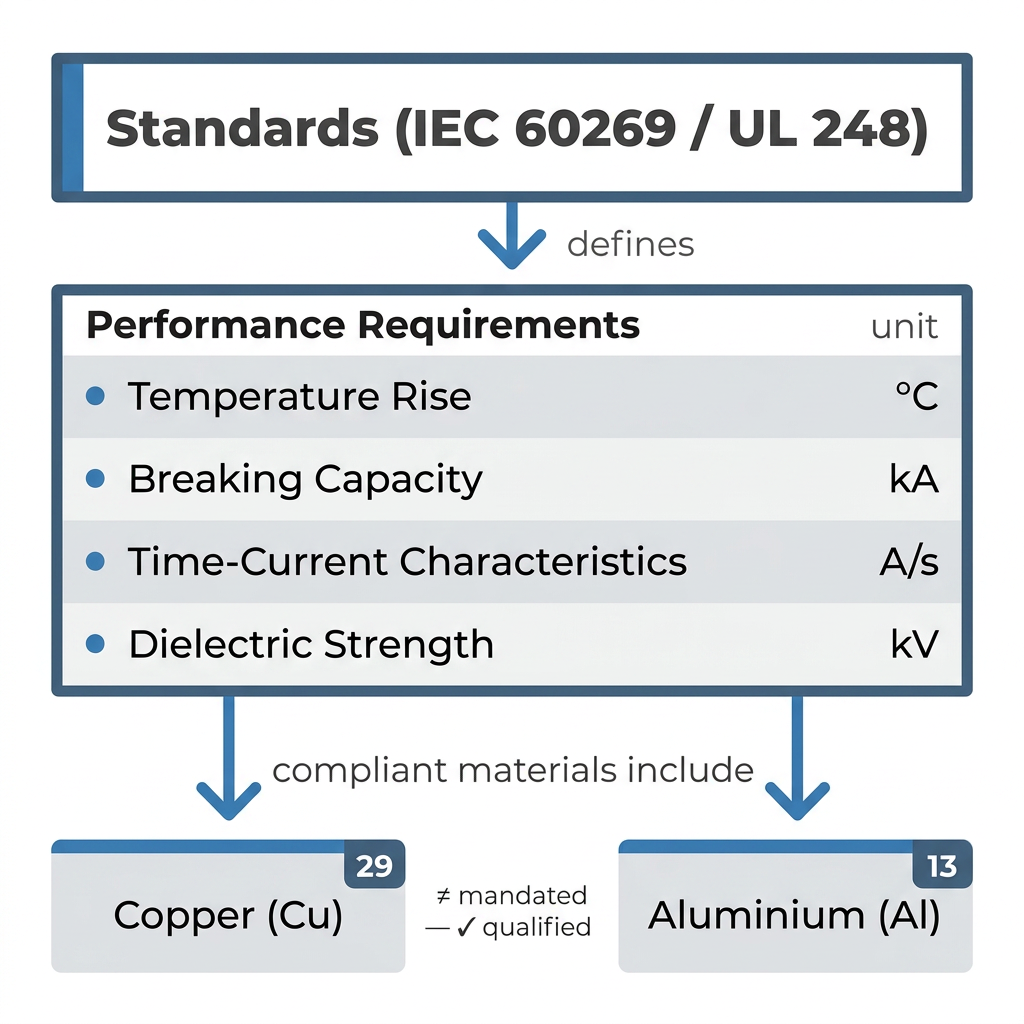
The core framework for LV industrial fuses in IEC markets is IEC 60269, especially Part 1 (general requirements) and Part 2 for fuses used by authorised persons (typical gG, aM, gR applications in industrial distribution and control). In North America, the corresponding umbrella is UL 248-1 (general requirements) together with the various product-specific parts such as UL 248-4, -6, -9, etc. for the different fuse classes.[6][7][8][9][1][2]
Across both frameworks, the common pattern is important:
- The standards define the characteristics of the complete fuse (fuse-link, and where applicable, fuse-base and carrier) so that compliant products with identical characteristics and dimensions are interchangeable.[10][1][2]
- They specify electrical, thermal, mechanical and safety performance: rated voltage and current, power dissipation, limits for temperature rise, time-current characteristics, breaking capacity and dielectric strength.[8][1][2]
- They do not prescribe copper as the only acceptable conductor material; instead, they require that whatever materials are used allow the fuse to pass the construction requirements and type tests.[4][1][2][3]
From an engineering perspective, this is crucial. The standards care about what the fuse does in service – how it heats, how it clears faults, how it withstands mechanical and thermal stress – not about which metal was chosen to achieve those outcomes.[1][2][8]
Key Normative Requirements for LV Industrial Fuse-Links
When you design or select a LV industrial fuse-link, several normative aspects of IEC 60269-1/-2 and UL 248-1 are directly relevant to any discussion of copper versus aluminium.[2][8][1]
1. Temperature rise and power dissipation
IEC 60269-1 sets limits on the temperature rise of accessible parts and terminals under specified load conditions, expressed relative to ambient temperature. Power dissipation of the fuse-link at rated current is also restricted so that the fuse does not overheat its surroundings or accelerate ageing of adjacent components.[8][1]
Under UL 248-1, similar requirements apply: fuses are subjected to operation tests where they carry rated current and overcurrents, and body and terminal temperatures must remain within specified bounds. In both systems, it is the measured temperature rise and watt loss that matter, not the intrinsic conductivity of the metal alone.[7][9]
For aluminium, this means:
- The slightly higher resistivity (~0.0283 Ω·mm²/m vs ~0.01724 Ω·mm²/m for copper) must be compensated by appropriate cross-section and geometry so that power dissipation stays within limits at rated current.[3]
- The temperature-rise tests simply verify that the design – aluminium or copper – meets the same numerical criteria.[7][1][8]
2. Time-current characteristics and breaking behaviour
IEC 60269-1 and the industrial Part 2 define time-current zones and test points for utilisation categories such as gG or aM: overload tests, conventional non-fusing and fusing currents, and short-circuit operation. UL 248-1 and the class-specific parts impose comparable overload and interrupting tests, including minimum sample sizes and prescribed test circuits.[9][6][1][2][7][8]
Here, the standard looks at:
- Pre-arcing I²t and total clearing I²t.
- Ability to interrupt specified fault currents at rated voltage without venting, rupturing or exceeding let-through limits.
- Consistency of time-current behaviour within defined tolerances.
Again, nothing in these clauses inherently forbids aluminium. The relevant question is whether the fusible element, joint design and fillers are tuned so that the aluminium-based fuse-link produces the required time-current curve and breaking performance.[1][2][8][3]
3. Construction, terminals and contact performance
Construction requirements cover clearances and creepage distances, mechanical strength, terminal design and, in some cases, the materials used for external parts (for example, corrosion-resistant or non-flammable housings). UL 248-1 includes provisions for terminal connection during testing, typically using copper busbars or conductors for reference, but the internal conductor material of the fuse-link is not constrained to copper.[7][8][1]
For aluminium-based fuse-links, this implies:
- The internal aluminium elements and contacts must be mechanically supported and guided so that thermal expansion (higher than copper) does not cause loss of contact pressure or deformation.[4][3]
- Surface treatments such as tin-plating or galvanisation are essential to control oxide layers, ensuring stable contact resistance over the life of the fuse.[3][4]
- Where the fuse interfaces to copper busbars or conductors, the terminal design must prevent excessive bimetallic heating and must still pass the standard terminal temperature-rise and endurance tests.[1][7][3]
If these construction conditions are met and verified in type testing, aluminium is fully compatible with the construction clauses of the LV fuse standards.[8][4][3][1]
The Physics Behind the Standards: Copper vs Aluminium
To decide whether aluminium can replace copper in a standards-compliant LV fuse-link, it helps to translate material properties into design levers rather than “pros and cons”.[3]
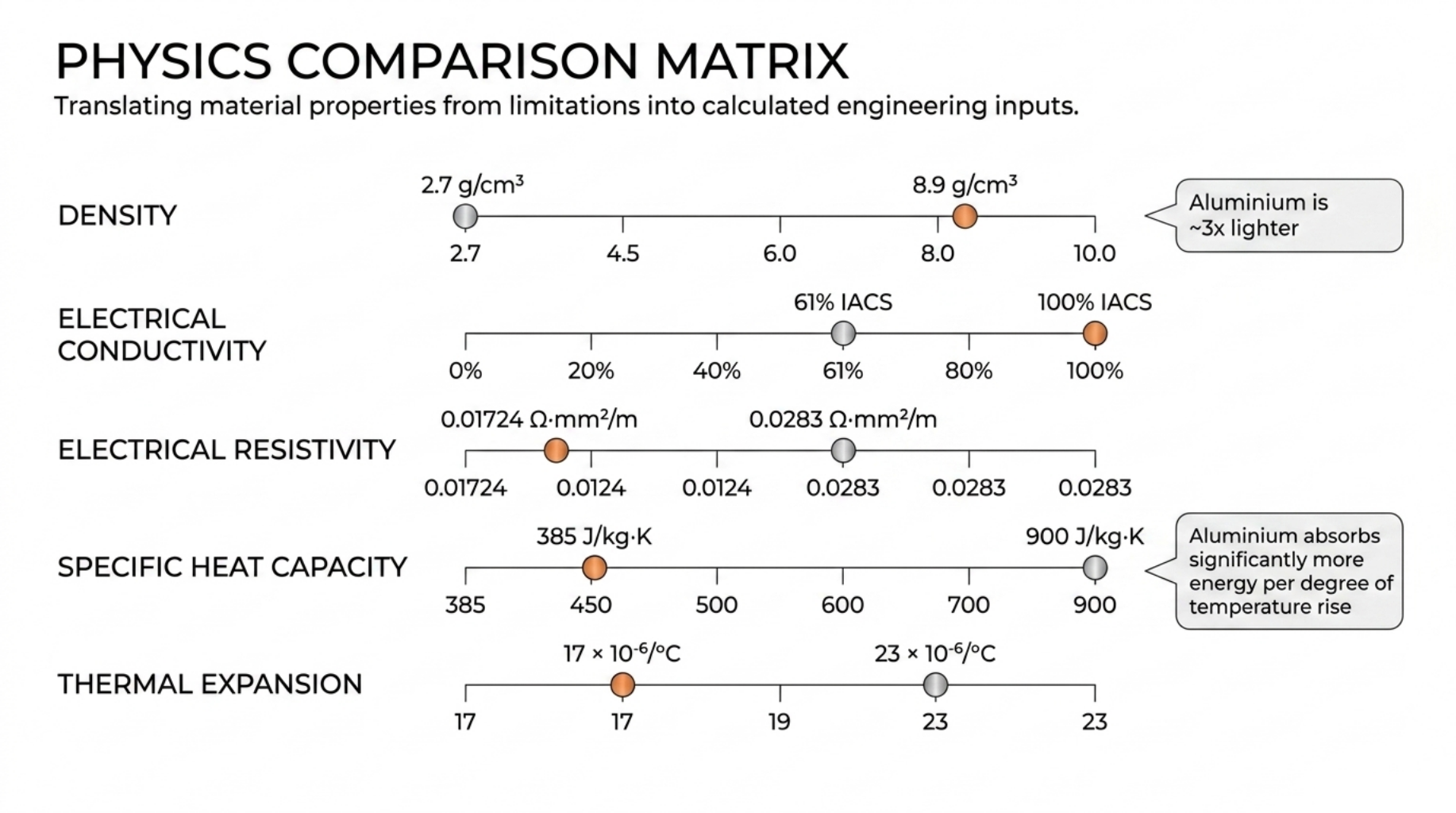
Electrical and thermal data at a glance
Typical values from established reference data are:[3]
- Density: copper ~8.9 g/cm³, aluminium ~2.7 g/cm³ (aluminium is roughly three times lighter for the same volume).
- Electrical conductivity: copper ~100% IACS, aluminium ~61% IACS.
- Electrical resistivity: copper ~0.01724 Ω·mm²/m, aluminium ~0.0283 Ω·mm²/m.
- Thermal conductivity: copper ~397–399 W/m·K, aluminium ~230–237 W/m·K.
- Specific heat capacity: copper ~385 J/kg·K, aluminium ~900 J/kg·K.
- Coefficient of thermal expansion: copper ~17 × 10⁻⁶/°C, aluminium ~23 × 10⁻⁶/°C.
In a LV industrial fuse-link, these numbers translate into:
- Slightly higher resistance per unit cross-section for aluminium, which is compensated by a modest increase in conductor area, while still benefiting from lower mass and therefore lower overall component weight.[3]
- Faster heat conduction in copper, but significantly higher heat capacity in aluminium, which helps aluminium absorb more energy before its temperature rises by the same amount.[3]
- Greater thermal expansion for aluminium, which must be managed via geometry, clearances and mechanical support – all topics that already fall under the construction and mechanical test requirements of IEC 60269 and UL 248.[8][1][3]
The standards do not ask “what is your material?”, they ask “what does your design do?” – and these data points show that aluminium can be engineered to answer that question correctly.[2][1][8][3]
Aluminium in the Test Lab: Meeting IEC and UL Requirements
How does this translate into actual testing for an aluminium-based LV industrial fuse-link platform?
Type tests under IEC 60269-1/-2
A typical qualification route for a new aluminium-based industrial fuse-link would include at least the following type tests, as defined in IEC 60269-1 and supplemented in IEC 60269-2:[2][1][8]
- Verification of dimensions and construction, including terminals, contact surfaces and clearances.
- Temperature-rise and power-dissipation tests at rated current and, where applicable, at specified overload currents.
- Time-current characteristic verification at defined test points for the relevant utilisation category (e.g. gG, aM), including conventional non-fusing and conventional fusing currents.
- Breaking capacity tests at specified short-circuit currents to verify safe interruption, overpressure control and absence of violent rupture.
- Dielectric tests before and after short-circuit operation to confirm insulation integrity.
If the aluminium fuse-link passes these tests, it is by definition compliant; IEC 60269 does not distinguish between “copper-compliant” and “aluminium-compliant” devices. For end users, the presence of the appropriate IEC symbols, ratings and utilisation category on the fuse body is what matters.[1][2][8]
Tests under UL 248-1 and relevant parts
For products intended for North America, the same aluminium-based design can be evaluated against UL 248-1 and the appropriate class-specific part (for example, Class J, RK, T, etc.). Here, the test series includes:[6][9][7]
- Construction review, including materials, clearances, terminal arrangements and markings.
- Operation tests (overload and time-delay performance where applicable).
- Interrupting tests at rated voltage and fault currents up to the stated interrupting rating.
- Temperature tests, in which fuse terminals are connected to copper busbars or conductors and must remain within specified temperature limits under load.[9][7]
The internal use of aluminium as the primary conductive material is acceptable provided that the overall device passes these tests and any specific material-related clauses (such as corrosion resistance or coating requirements for current-carrying parts) are satisfied.[9][7][3]
Beyond Compliance: System-Level and Environmental Impact
Once a new LV fuse-link platform based on aluminium has passed both IEC and, where needed, UL qualification, the discussion moves from “Is this allowed?” to “Is this advantageous?”.[2][8][1]
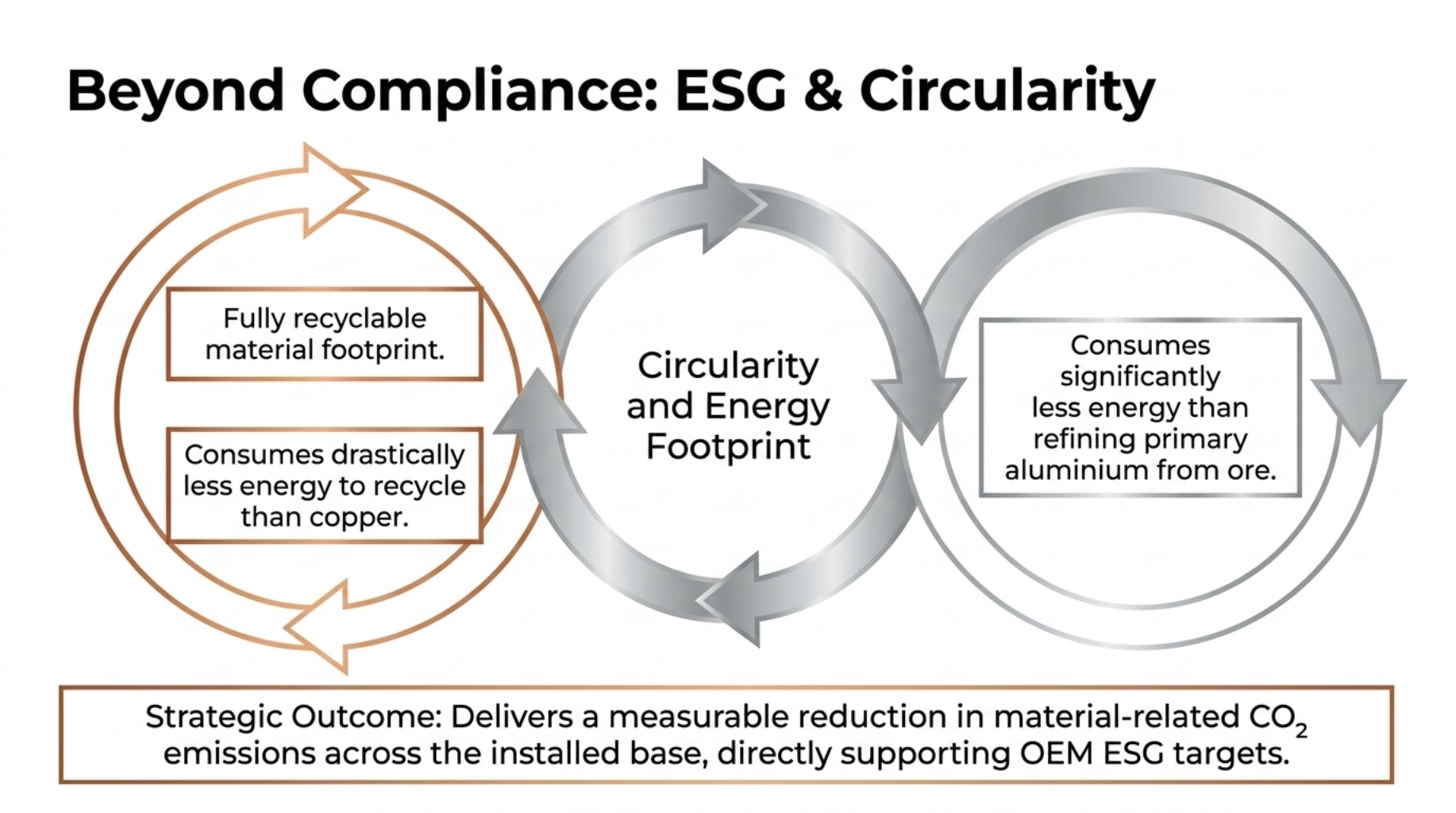
Several factors make aluminium particularly attractive for modern LV installations:
- Weight and logistics: With density around one-third of copper, aluminium-based fuse-links and subassemblies reduce total shipped mass per installed ampere, directly lowering transport energy consumption and cost in high-volume projects.[3]
- Resource and price stability: Aluminium is more abundant and tends to be more price-stable than copper, which helps manufacturers and OEMs manage material cost volatility over long product lifecycles.[5][3]
- Circularity and energy footprint: Aluminium is fully recyclable and requires far less energy to recycle than copper; it even consumes significantly less energy to recycle than to produce primary aluminium from ore. Across the installed base, this translates into a meaningful reduction of material-related CO₂ emissions.[5][3]
For panel builders, OEMs and system integrators operating under strict ESG or circularity targets, these system-level benefits are highly relevant – provided, of course, that the fuse-links retain the performance and coordination behaviour required by IEC and UL.[5][8][1][2][3]
Design Caveats: Where Engineering Still Matters
None of this means that aluminium is a drop-in swap for copper with no extra thought. On the contrary, it rewards careful engineering and validation.
Key design caveats that responsible manufacturers address explicitly include:[4][3]
- Contact interfaces and oxide control: Aluminium naturally forms an oxide layer that can increase contact resistance. In qualified products, this is mitigated through plating (e.g. tin), appropriate contact pressures and tested joint designs, ensuring that contact resistance remains stable over life and that temperature-rise limits are not exceeded.[4][3]
- Thermal expansion and mechanical support: The higher coefficient of thermal expansion requires that elements and contacts are guided and supported to avoid loosening or misalignment under thermal cycling. This is verified through repeated loading and temperature-cycle tests within the IEC/UL framework.[8][1][3]
- Interfaces to copper infrastructure: Most LV systems still rely heavily on copper busbars and cables. Terminals on an aluminium-based fuse-link must therefore be designed and tested to manage bimetallic effects and maintain low joint resistance and acceptable surface temperatures under rated and overload conditions.[7][1][3]
For end users, the most practical signal that these issues have been handled is the presence of relevant IEC/UL marks, ratings and coordination data in the manufacturer’s documentation – supported, where appropriate, by application notes and test data.[7][1][2][8]
When to Choose Aluminium-Based LV Fuse-Links
So in which scenarios does an aluminium-based LV industrial fuse-link make the most sense?
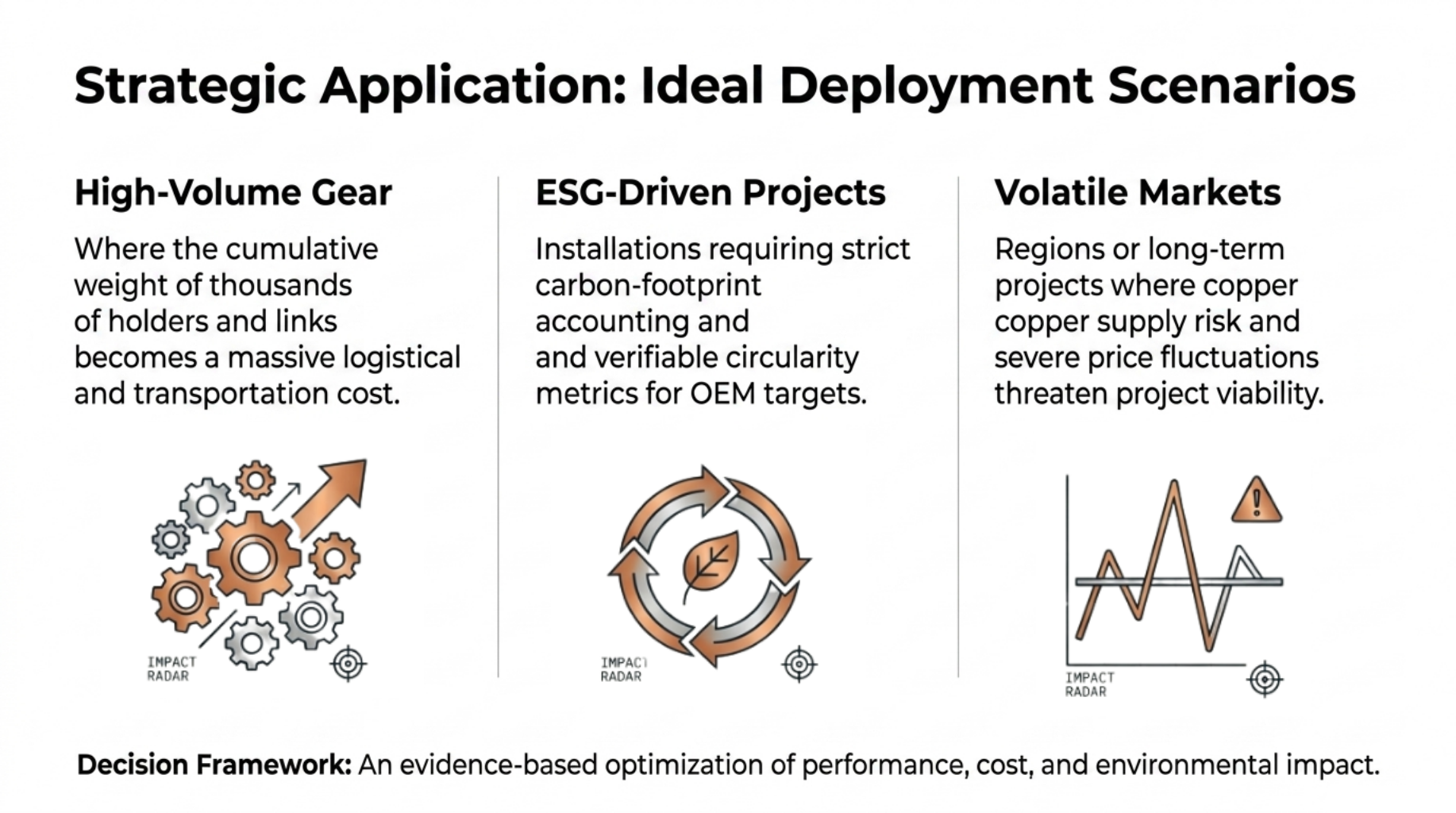
Typical cases include:[5][4][3]
- High-volume industrial distribution and control gear, where the cumulative weight and material use of thousands of fuse-links and holders becomes a tangible logistical and sustainability factor.
- Applications with strong ESG, carbon-footprint or circularity targets, where the lower energy cost of aluminium recycling and reduced transport emissions contribute directly to project KPIs.
- Projects or regions where copper price volatility and supply risk are strategic concerns, and aluminium provides a more stable material basis without sacrificing standards compliance.
In all these cases, the decision should remain data-driven. If an aluminium-based fuse-link platform offers IEC 60269 and UL 248 compliance, provides the coordination data you need and aligns with your system design, it is not a “second-tier” choice – it is a standards-backed optimisation of performance, cost and environmental impact.[4][5][1][2][8][3]
Closing the Series: From Tradition to Evidence-Based Choice
Copper will remain an important and often optimal material in fuse-links for many years to come. But tradition alone is no substitute for hard data. When we look at the physics, the IEC/UL test regimes and the system-level impact, aluminium emerges as a credible, standards-compliant and often advantageous alternative for LV industrial fuse-links – especially when weight, sustainability and material strategy enter the equation.[5][1][2][8][4][3]
The real question for design and procurement teams is no longer “Copper or aluminium?” in isolation, but “Which standards-compliant fuse-link platform delivers the best overall value for this installation?” For many modern LV systems, an aluminium-based, fully tested and certified fuse-link will be a very solid answer.
Sources
- IEC 60269-1 sample PDF
- IEC 60269 overview
- Copper vs Aluminium: Which Is Better for Electrical Applications?
- Aluminium Contacts | UL and IEC Standards
- Copper vs Aluminium | Impact
- UL 248 standard series
- UL 248-1 reference PDF
- IEC 60269 preview
- Littelfuse UL/CSA fuse classes and applications guide
- IEC 60269-1 publication page
- IEC 60269-2:2013 sample PDF
- IEC 60269-2-1 preview
- IEC 60269-2-1:2004 sample PDF
- Copper vs Aluminium – Electrical Considerations in EHV Underground Cables
- Copper vs. Aluminum Connectability Test
- Breakdown Voltage Performances of Aluminum and Copper Conductor Wire Under Compression Stresses
- Additional IEC preview